

Working on a new project.
From initial load estimation to an approved design report, each system is assessed, sized, simulated over a horizon agreed with the client (typically 5 to 20 years), costed and verified against the applicable standards.
Comprehensive assessment, followed by sizing against the load
The accuracy of sizing depends on the three assessments on which it is based. Each assessment is built on measured data before any component is selected.
- Load assessment — data centre, residential or industrial: demand profile, peaks, diversity, growth and criticality
- RES assessment — solar and wind resource from multi-year reanalysis data, plane-of-array irradiance and hub-height wind
- ESS assessment — battery or hydrogen: round-trip efficiency, depth of discharge, degradation and duration required
- Sizing RES & ESS against the load — the combination that meets the reliability target at the lowest lifetime cost
Sizing on live data. Adjust the sliders to recalculate the reliability, grid and self-use figures against real weather data for the site. This demonstrates the fourth step above, sizing renewables and storage against the load, with full transparency.
Multi-year simulation before construction
A model that replicates the behaviour of the plant, taking real weather data as input and producing dispatch decisions as output, over a horizon long enough to capture adverse years.
- Modelling of load, RES and ESS with pattern analysis, with diurnal, weekly and seasonal structure extracted from the data rather than assumed
- RES generation driven by a real-time weather API, so that the twin reflects current site conditions
- ESS operation coupled to load and generation, with charge, discharge, state of charge and grid exchange resolved at every timestep
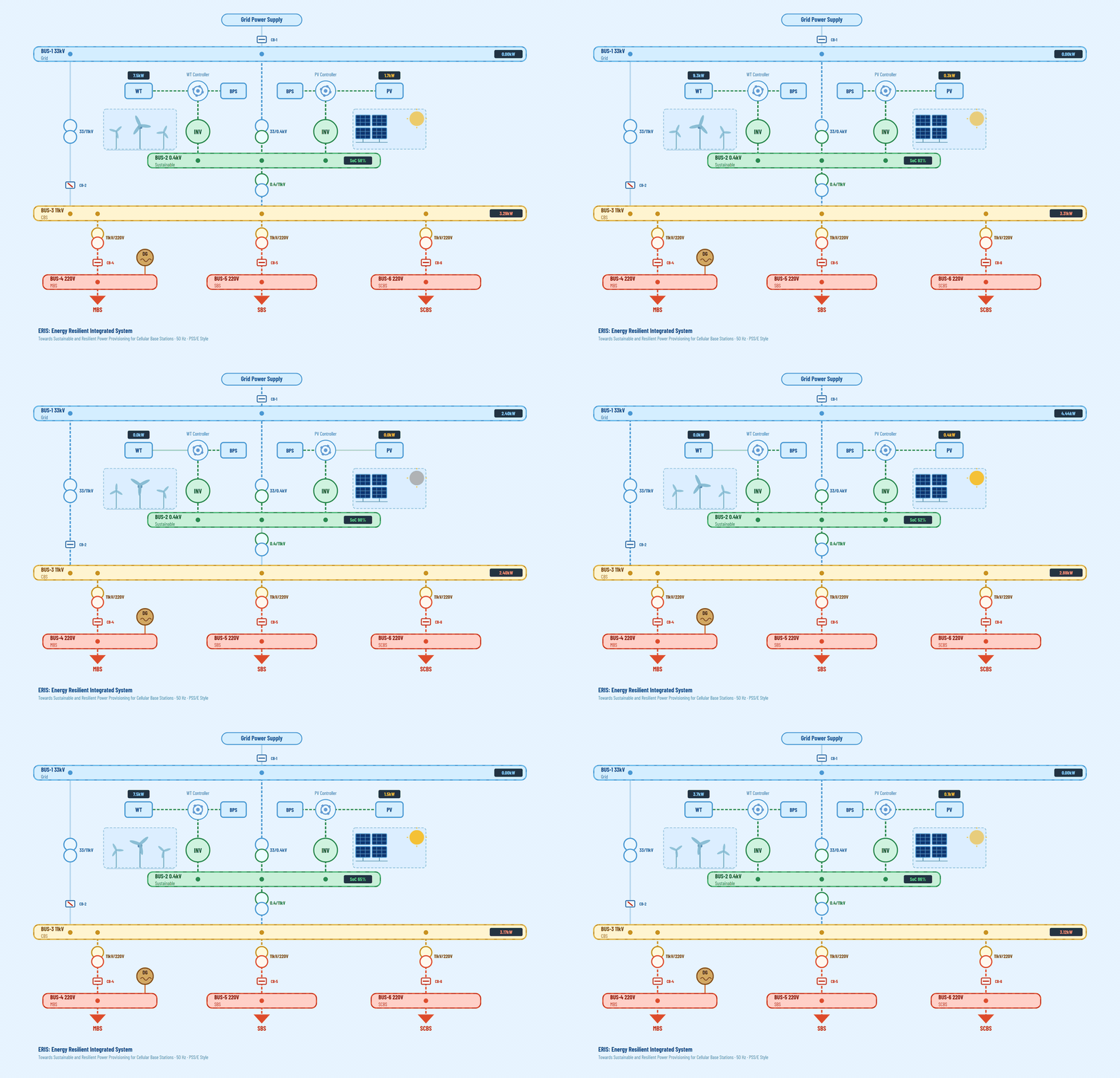
- A full virtual SCADA system for robust and extreme testing: multi-year runs, outage scenarios, worst-week cases and long-horizon studies of typically 5 to 20 years
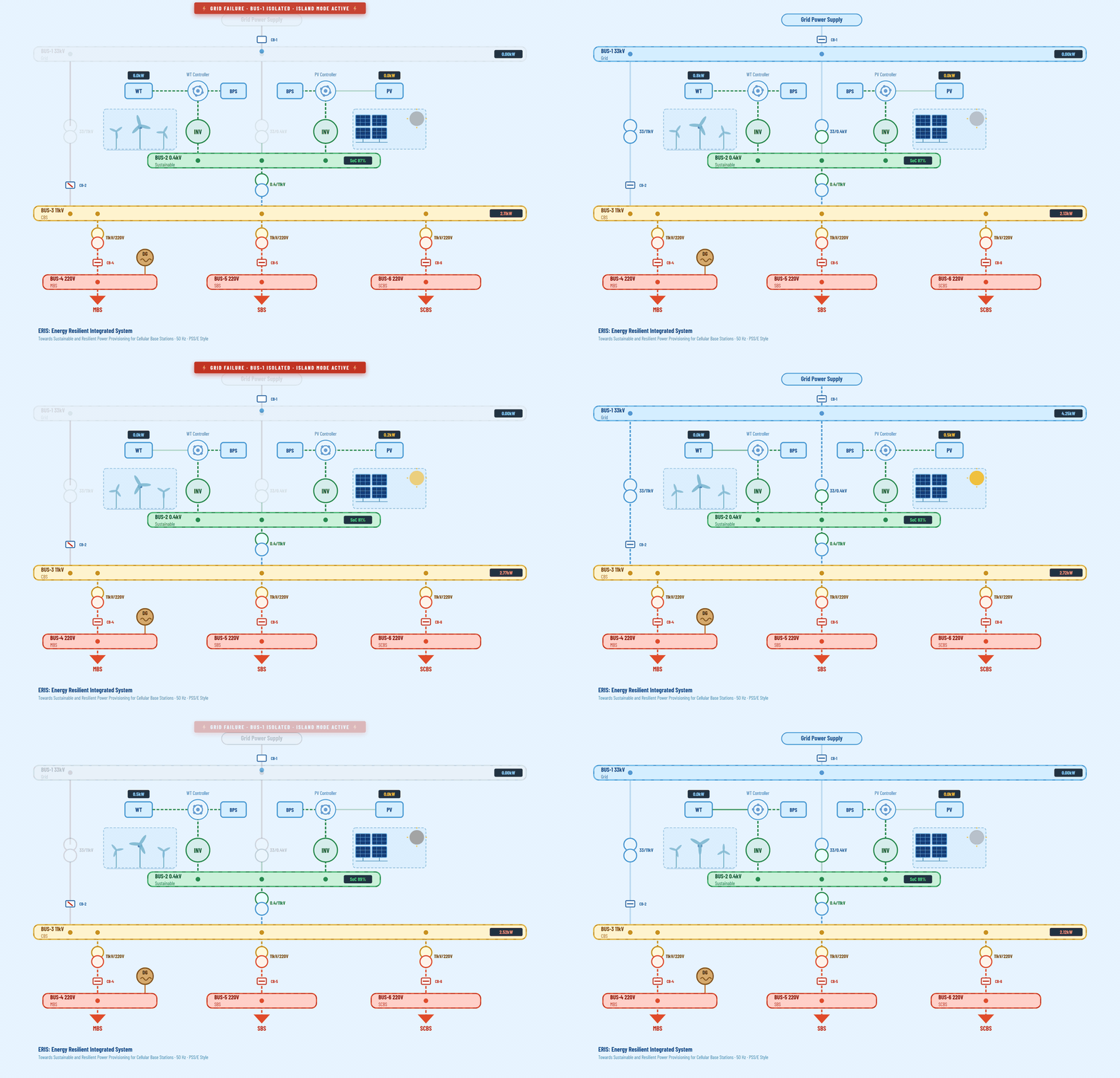
Virtual SCADA view. The single-line diagram an operator would monitor, driven by the digital twin rather than by field instruments. Live weather data is the input; generation, storage and grid exchange are the outputs, updated hourly.
Technical and economic feasibility
The digital twin produces the energy balance, and the feasibility analysis converts it into an investment decision that can be justified to a board.
- Feasibility check — verification that the sized system serves the load under the reliability criteria defined at the outset
- Year-by-year trajectory — generation, unserved energy, storage degradation and grid dependence tracked across the horizon
- Full cost analysis — capex, opex, replacement, LCOE, NPV and payback on a referenced cost basis
- Option comparison — design options compared side by side, so that the recommendation is supported by a quantitative ranking
Applicable standards and compliance
Compliance is documented explicitly in the report, clause by clause. The applicable standards are confirmed with the client at project initiation and depend on the jurisdiction and connection point.
Electrical standards
Wiring rules, cable selection and current-carrying capacity, switchgear and controlgear assemblies, protection coordination, earthing, harmonics and power quality, and substation communication where SCADA integration is in scope.
RES standards
PV array installation and DC-side safety, grid connection of inverter energy systems, PV performance monitoring, wind turbine design and power-performance measurement, and battery energy storage installation and safety.
Load standards
Data-centre infrastructure and redundancy tiers, generating-set and standby supply requirements, emergency and critical-supply provisions, and reliability assessment for industrial and commercial power systems.
Project deliverables
Full design report
A single document covering every stage above: assessments, sizing, digital twin results, feasibility, cost analysis and the standards verified, with all assumptions and data sources stated.
The digital twin
Delivered as a working model that the client can re-run when the load, tariff or site conditions change. Scoped separately by agreement.
Models & data
Sizing workbooks, dispatch time series, exportable logs for real-time simulation platforms, and component specifications with datasheets.
Have a site or a load profile in mind?
Share the available project information, even at a preliminary stage, and we will advise on what is feasible.
Request a consultation →